Crew rights on paper and on board.
Fishery Audit writes the policies, procedures, record forms, crew notices and training that social audits ask Taiwanese vessel owners for: in Chinese for the owner, and in the crew's own languages for the people on board. Each set carries the owner's company and vessel names, ready to sign and use.
- 116 documents across 16 crew-rights topics, from forced labour and recruitment fees to grievance mechanisms
- Written against ILO C188, Taiwan's rules for foreign crew employed overseas, and buyer codes such as the Seafood Task Force Code of Conduct
- Crew-facing documents in Chinese, English, Indonesian, Filipino and Vietnamese
- Licences for whole supplier bases, not just single vessels
The pressure on Taiwanese vessels is rising
Taiwan runs one of the world's largest distant-water fleets, landing about a fifth of the world's longline-caught tuna, mostly crewed by migrant workers from Indonesia, the Philippines and Vietnam. Importers, brands and governments now expect evidence that those workers' rights are respected.
Owners want to comply. Most can't show it.
The most common audit finding on Taiwanese vessels is not the absence of a practice but the absence of a record of it. Buyer codes are written in English for an international audience; the people who have to put them into practice are owners, shore managers and captains working in Chinese, with crews who read neither.
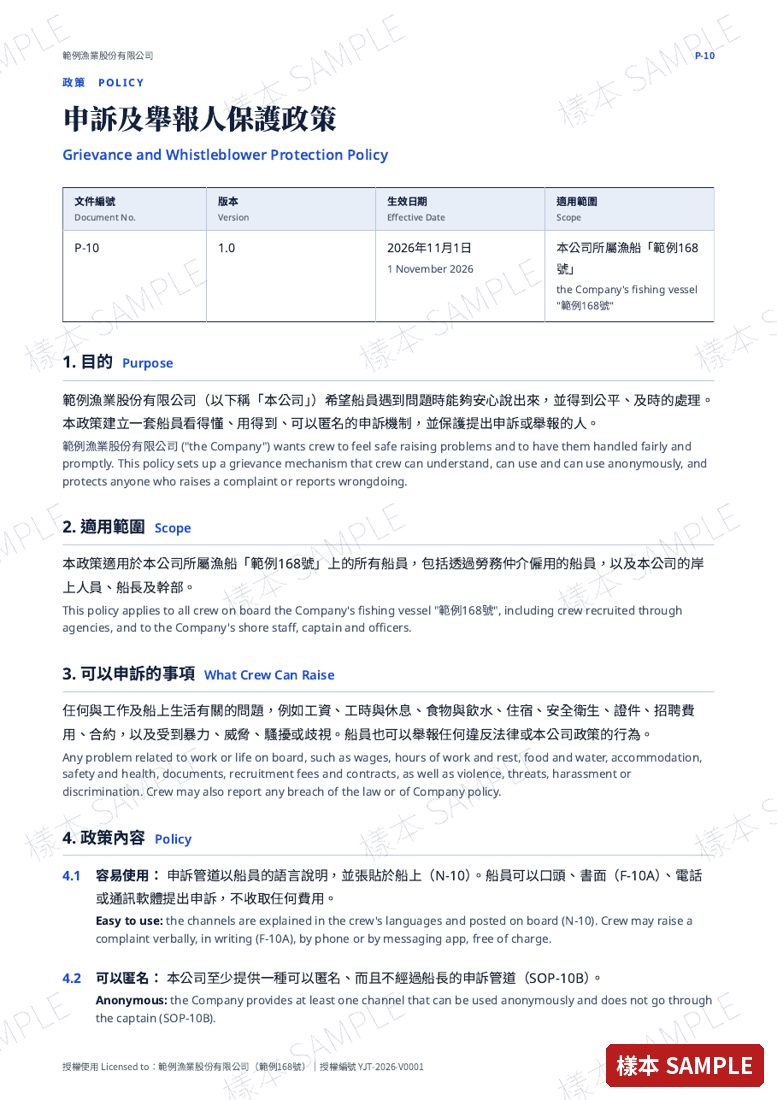
Fishery Audit closes that gap. Every pack turns a topic of a buyer's code into the documents an auditor will ask to see: a policy signed by the owner, a step-by-step procedure and the record forms to keep, plus, where the topic calls for them, notices to post on board and short crew training with a test.
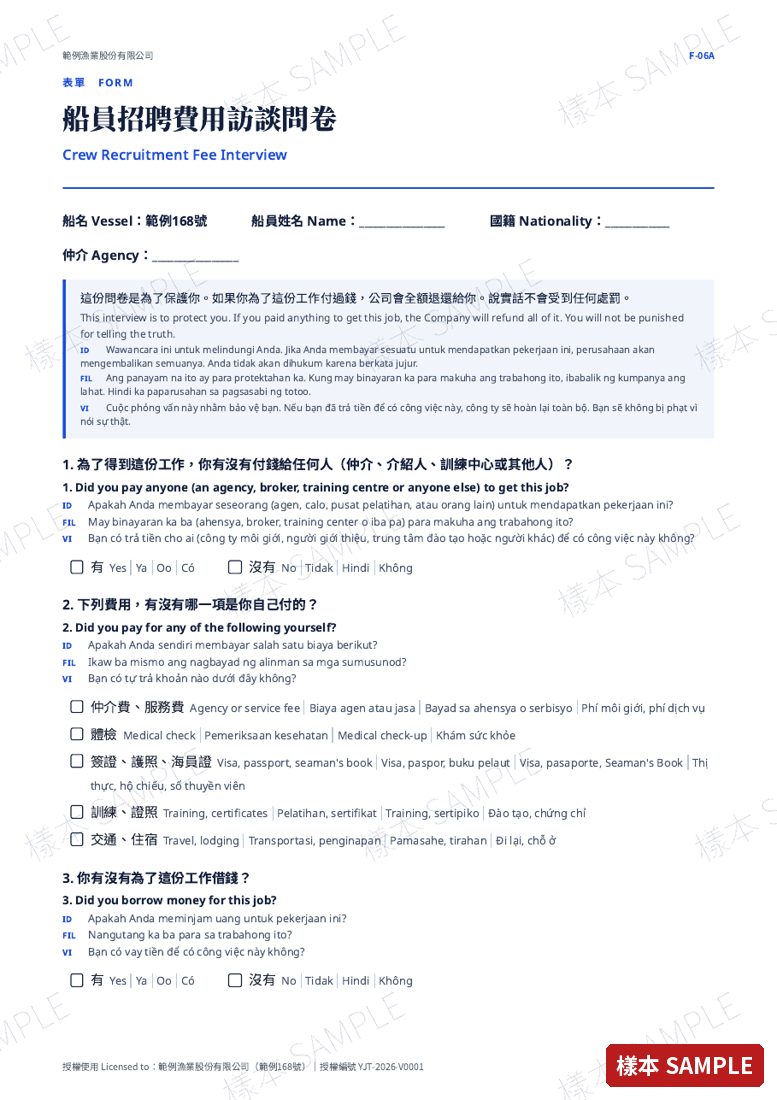
- A recruitment-fee interview, asked in each worker's language, that commits the company to refund any fee a worker paid to get the job
- Grievance notices that list the Fisheries Agency's hotlines and its complaint platform in five languages, alongside the company's own channels
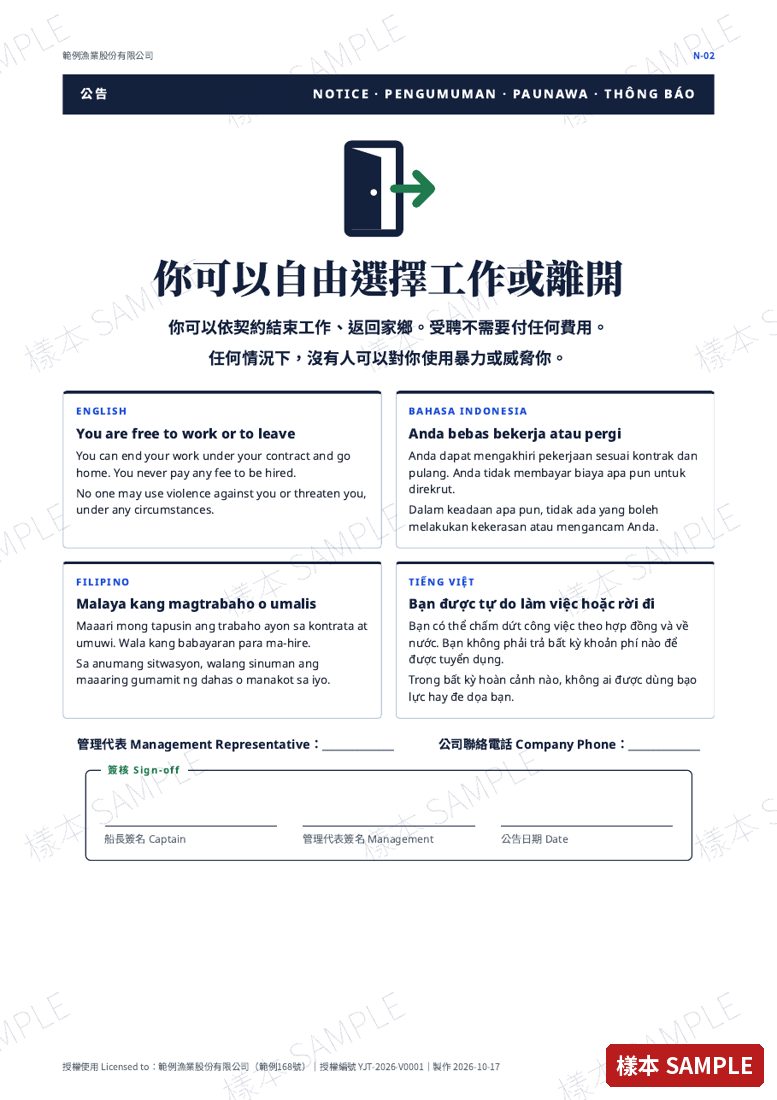
- Notices telling crew, in their own language, that they can leave, keep their documents and refuse to pay for their jobs
- Usage guides that tell owners plainly that documents alone don't pass an audit: practice on board and honest records do
16 topics, 116 documents
The crew-rights and health-and-safety topics that buyer audits of fishing vessels focus on. Each pack contains policies, procedures and record forms, plus crew notices and training where the topic needs them.
Not covered: fisheries legality and traceability (licences, logbooks, VMS, transhipment), environmental management, vessel certificates and safety equipment, and crew members' personal documents.
What the documents look like
Owner-facing documents are bilingual Chinese and English; anything crew read or sign is in all five languages.
Taiwan's rules, explained in English
Much of what governs crew on Taiwan's fleet is published only in Chinese. Our guides explain it, with links to the original sources.
For buyers, traders and NGOs
If you source from Taiwanese vessels or work with their crews, you can put the documents in your suppliers' hands without asking each owner to find, translate and adapt them on their own.
Supplier programme licence
- For importers, brands, traders and processors with Taiwanese supplier vessels
- You fund the packs; each supplier company receives its own set, carrying its own company name and licence number
- All 16 topics or only the ones your code or audit findings call for
- Fleet licences: every vessel the supplier company operates is covered
- Delivered straight to each supplier, or to you to distribute
Partnerships
- For NGOs, worker organisations, training providers and industry programmes
- Use the documents in owner training, remediation plans or capacity-building projects
- Adapt them to a programme's own standard or add further crew languages
- Tell us what you're working on, and we'll work out terms that fit
For reference, a Taiwanese company buying directly pays NT$16,800 for all 16 packs under a fleet licence. Supplier programme pricing depends on the number of companies; ask for a quote.
Questions we get asked
Who are the documents written for?
Taiwanese vessel owners and their shore managers and captains, who run the system day to day, and the crew, who need to understand their rights and sign the records. Policies and procedures are bilingual Chinese and English, so a buyer or auditor can read them too.
Is this a certification or an audit?
No. Fishery Audit does not audit or certify vessels. The documents help an owner build and record a management system; whether it works is for an independent audit and, above all, the crew to judge. Owning the documents does not guarantee any audit result.
Which standards are the documents based on?
The ILO Work in Fishing Convention (C188), Taiwan's regulations on employing foreign crew overseas, and the topics that buyer codes of conduct for fishing vessels, such as the Seafood Task Force Code of Conduct, have in common. Where Taiwanese law sets a higher bar than C188, for example a minimum crew age of 18, the documents follow Taiwanese law.
Can we see a full sample before we commit?
Yes. Email service@fisheryaudit.com and we will send sample documents for the topics you are interested in.
Can the documents follow our own code of conduct?
The packs already cover the topics most buyer codes share. If your code has specific requirements, tell us which, and we can discuss adapting the documents for your suppliers.
Who runs Fishery Audit?
Fishery Audit (漁稽通 in Chinese) is an independent service operated by Takao LLC. It is not affiliated with any buyer, certification scheme or audit body.